
Every year, the advertising industry turns its attention to the Super Bowl. Agencies gather to dissect the campaigns, brands monitor the online reaction, and marketers debate which commercial deserves the crown. Did a celebrity cameo deliver? Was that $8 million media investment worth it? And, most importantly, which brand managed to “break the internet”?
Few events give advertising the kind of concentrated public attention that the Super Bowl does. For one night, commercials become part of the main event. But while the industry is busy scoring the latest creative efforts, I think there’s a more revealing question worth asking:
Which Super Bowl ad do you remember most?
Not which one you liked last Sunday. Not which one generated the most social media buzz. Which one has stayed with you for years, or even decades?
That distinction matters. Because the real measure of great advertising may have less to do with winning the conversation on the night and more to do with earning a permanent place in people’s memories.
The past still has a powerful hold
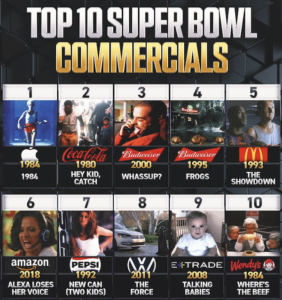
When we put that question to the American public, the results were telling. Rather than a parade of recent celebrity appearances and big-budget productions, people recalled campaigns from another era.
Budweiser’s Frogs and Whassup?. Coca-Cola’s Hey Kid, Catch!. Apple’s 1984. Pepsi’s New Generation.
These are campaigns from 30 or 40 years ago, yet they continue to feature prominently in people’s recollections of Super Bowl advertising.
That’s more than a nostalgic trip down memory lane. It raises a fundamental question for anyone working in marketing: what makes certain advertising ideas stick, while others disappear almost as soon as the media spend runs out?
Looking at the campaigns that have stood the test of time reveals a few useful clues.
First, make people feel something
The most memorable ads tend to give audiences an immediate emotional reason to pay attention. Sometimes that’s laughter; sometimes it’s warmth, curiosity or a moment of genuine intrigue. The approach varies, but the common thread is an emotional connection that doesn’t require much explanation.
Emotion, of course, isn’t the same thing as effectiveness. Making someone laugh or feel good is not enough on its own. But an emotional response can provide the initial spark that helps an ad cut through, makes it easier to process and increases the likelihood that it will be remembered.
Budweiser is a particularly good example. Much of its most enduring work doesn’t rely on overwhelming audiences with production values or increasingly elaborate spectacle. Instead, it creates accessible, often charming moments that make the brand feel familiar and human.
The implication for marketers is worth considering. Rather than asking how an ad can make the biggest possible impression, perhaps we should ask what immediate feeling it gives people a reason to associate with the brand.
Emotion won’t guarantee a place in memory. But without something that captures people’s attention and gives them a reason to care, creating that lasting impression becomes a much harder task.
Simple ideas have a longer shelf life
There’s another characteristic shared by many of these enduring campaigns: you don’t need a lengthy explanation to describe them.
A few frogs croaking a brand name. A familiar greeting that became part of popular culture. A memorable exchange between a child and a sporting hero. These ideas are easy to recall because their essential premise is so straightforward.
And that simplicity gives them an advantage beyond the original commercial. People can repeat the line, retell the story or reference the idea in conversation years later. The advertising continues to circulate, carried by the audience rather than the media budget.
Of course, simple doesn’t mean simplistic. The best ideas often look obvious only after someone has found them.
Budweiser’s frogs, for example, may sound like an unlikely foundation for a major advertising success. Getting three amphibians to spell out “Bud–Weis–Er” hardly sounds like a guaranteed winner in a creative pitch. Yet the idea was distinctive, immediately understandable and easy to reproduce in people’s minds.
That is the craft: stripping away the unnecessary until the central idea is strong enough to survive repetition, changing tastes and the passage of time.
In an industry that often rewards complexity, there’s a compelling case for remembering the commercial power of a simple idea.
Make sure people remember the brand, too
Being memorable is one thing. Being memorable for the right reason is another.
The campaigns that stand out in these rankings tend to have a particularly strong relationship between the creative idea and the brand behind it. The two are so closely connected that moving the idea to another advertiser would fundamentally change its meaning.
That connection is important because advertising isn’t an entertainment contest. Its purpose is ultimately commercial.
A campaign might generate laughter, conversation and millions of views, but if people remember the joke and forget who paid for it, much of its potential value is lost.
The strongest work builds the brand into the experience itself. The audience doesn’t have to be reminded who the advertiser was after the commercial ends. The brand is already part of what made the idea distinctive.
For marketers investing heavily in an event such as the Super Bowl, this is a particularly important consideration. The objective isn’t simply to be remembered. It’s to make sure the brand is remembered alongside the advertising.
Don’t confuse cultural relevance with chasing trends
The final pattern is perhaps the most interesting. Many of the campaigns that have aged best were built around ideas that could outlast the cultural moment in which they appeared.
They were products of their time, certainly. But they also tapped into themes with a longer shelf life: humour, human connection, identity and the role brands play in everyday life.
Contrast that with the temptation to build an entire campaign around whatever happens to be dominating the conversation. Remember the “NFT Super Bowl”?
Cultural relevance can be valuable, and timely references can help a brand feel connected to its audience. The risk comes when the reference becomes the idea itself. Once the trend passes, the advertising can lose much of its meaning with it.
The campaigns that endure tend to offer something more substantial. They use the moment as a vehicle for an idea that can continue to resonate after the original context has disappeared.
That’s a useful distinction for brands navigating an environment in which trends emerge and disappear at extraordinary speed. Being relevant today is valuable. Creating something that still means something tomorrow is even better.
The lesson isn’t to look backwards
None of this means marketers should recreate the advertising of the 1980s or 1990s. Nostalgia is not a strategy, and what worked for one brand in one era won’t necessarily work for another today.
But the continued prominence of campaigns from 30 or 40 years ago does challenge some of the industry’s assumptions about what makes advertising successful.
We spend enormous amounts of time discussing media innovation, new platforms, production techniques and the latest ways to generate attention. These things matter. Yet the fundamentals revealed by the most memorable Super Bowl ads are remarkably consistent.
Give people an immediate emotional reason to engage. Build the idea around something simple enough to remember and share. Make the brand an unmistakable part of the experience. And aim for something with the potential to outlast the cultural moment that gave it an opportunity to shine.
Those principles apply whether you’re investing $8 million in a Super Bowl commercial or $8,000 in a local television campaign. The scale of the investment changes. The challenge of making an impression that lasts does not.
The advertising industry will always want to know which commercial won the Super Bowl. It’s an understandable question, particularly when so much money and creative ambition are on the line.
But perhaps we should spend less time asking which ad won the night and more time asking which ones will still be remembered 30 years from now.
Because there’s a fundamental difference between buying attention and earning a place in someone’s memory.
Short-term impact can be bought. Long-term memory has to be earned.
